Week 12 : Finals -- Update / Documetation in the final weeks
Dec 10 , 2025 


Learning & Process in training of StyleGANs 

In the past 2 weeks I’ve been trying training on both Google Colab as well as my local machine, yet has failed for various reasons (mainly compatability issues on local machine, or speed in Google Colab). Eventually after classmate’s suggesiton I realize that it might be because that styleGAN is too large to be trained on Google Colab -- I’m currently trying to train using Jupyter Notebook (still setting up NYU VPN though so would be updating here once it work out). 

Google Colab -- 

I tried both StyleGAN2 ADA and StyleGAN 3.

Started off from other people’s notebook, I added code to set up virtual environment to Python 3.8 (thanks to Ryan from coding lab), as well as installing all the right versions of the packages. After failing (due to incompatibility) or forced restart for countless times during the process, I evnetually got to a point that the training get started. However, none of the trianing got completed -- for the last times (around 5 + times), the model got trained for more than 4hr, yet, eventually stopped because of session time out. They also only got trained for at most 10 ticks (which is a fraction of the total number of ticks), so it shows that Google Colab was just extremely slow and could not complete the task... Even if I change the kimg down to 500 from 2500, hoping that this would run faster, it still showed “run session timeout”


Local Machine on Nvidia GPU --  

I have also tried both StyleGAN2 -ADA and StyleGAN3  -- however, after consecutive 5 days and the help from 4 coding lab mentors who passed the (py)torch one by one with me, facing different errors for hours and hours, we still could not install the exact compatible packages. 

However, I did learn a lot about command lines and felt much more comfortable to operate (?) with the command line, also some a lot of basic python concepts and commands, which are super interesting -- how does these command lines works in general. 

But for the errors, the gist is that, the versions of torch and verion of CUDA is always not compatible -- since they are in pair, if one goes higher or lower the other one need to adjust accordingly, but then it would not fit the requirement. This is also an issue possibiliy because this is an older model from a few years ago, so that it’s tricky to find the exact compatible. 

below is just an example for the error messages. 


WHAT I LEARNED -- 

To be fair this process is pretty rewarding -- I learned that for training model it’s not that how much you pay how much you gain (jk), and realized how much of it really is compatibility issues. Even though the coding lab mentors told me it’s not always like this, that training for a model would be max for like a day, but here I am with this.. 

But on a brighter side, I did learn a lot with the command lines and got more familiar with how python works, what their language means, and what does training a model requires, what are the steps, how to prepare the data, etc. 

Now I really just wish to train it! trying with Jupyter Notebook!

Also, for the Shared Mind-inspired performance, dimensionality, check out the documentation here!!


Week 11 : Finals -- Update / Documetation
Dec 3 , 2025 


Training Model in Google Colab: 

For the project I would be training my own StyleGAN model. 

I started with some existing google colab notebook, first used a StyleGAN2 ADA (reference this tutorial & notebook ), then turned gear toward StyleGAN3 (reference this notebook ). However, the issue that keep appearing is the version issue -- so far most of the time dedicated in the notebook is to change / downgrade to lower versions of Pytorch or other specific packages so that the model could run... 

Then, I decided to try training on my own machine -- However, similar issues happened. After downloading all the corresponding version of the packages, and try trianing on both StyleGAN2 ADA and StyleGAN3, they all failed on a similar issue of compatability. (then claude saying that they would recommend using Google Colab). 


Collecting Data Set for Training

I started the project with “data” collection -- in this case, the data being all the beautiful cave paintings across time, in Mogao Cave, from Dunhuang,. China.  Although I’m not in China so it’s hard to borrow physical copies of historical picture books, I do have a book 敦煌飞天 that’s a mix of text and images, encompassing the history and wide range of culture that is reflected through the paintings. I’m using this book as a fact- checking tool. 

After scrapping images from online articles (not too much luck of finding real authentic painting.. feeling a bit of the dead internet theory), I found the pdf version of this book 敦煌石窟全集 --敦煌飞天书卷 (Collection of Dunhuang Grottoes -- Dunhuang Flying Diety Scrolls). I ended up screenshotting the images in the book, labeling them in their each corresponding dynasty (historical time frame). 


Week 10 : Finals Proposal
Nov 26 , 2025 


----


Week 10 : production of the body today
Nov 5, 2025 


I remember when first taking ICM, my biggest confusion was why I'm coding, when there could be zillions of SWE// people who are already so good at or better at coding than I do. I also was quite confused about why we use P5 to draw, or computational ways to make music (?) when there are painters/ fine-artist/ musicians. I was intimidated


But I think as I'm taking this class, the higher level structure/ system behind the code, and machine learning, just became so intriguing. I remember first hearing/ encountering the latent space, embeddings, high dimensional spaces, the conceptual meaning behind these terms -- how they could be interpreted both within the code& computation, or in large, is super fascinating -- (thanks to Dan O and this class for showing the connection between the embodied world and these computational terms). So many different ways of interpretation of these terms as well, and sometimes I think of this act of re-interpretation or providing different discourse, as in this alternative world-building // meaning-making.


the concept of Computational X, and formalism, that Wolfram mentioned in the podcast is very interesting.
I like the differentiation, between CX and CS. (no shade but) i've seen so many jokes on reels/ IG about how hard it is now young college student learn CS for a job but a job is not a guaranteed anymore. All the high education that's pre-professional driven face this similar problem. But I love the idea of seieng how instead of studying CS to be a programmer, integrating computational ways of thinking in the existed disciplines and see how they could show up/ take place/ or even change the disciplines, to serve the meaning of education (in my opinion) -- to make sense of the world, to constantly be curious, to build your own unique way of looking and understanding and values.
I was curious so I searched up "computational anthropology" -- essentially, how the new technologies have helped the process of anthropologists' research & exploration -- "Enhanced Data Collection and Processing, The Role of NLP in Ethnographic Analysis, Visualization and Interpretation of Complex Data"
"the introduction of technologies such as SUDAAN, WeftQDA, and Tableau has allowed anthropologists to study clustered datasets, graph complex and interlinked swaths of data, and analyze textual data such as interview transcripts and field note"
Anthropologist Morten Pedersen has talked about using computational methods in anthropology research -- which could be not easy since how much emphasis there are on ethnography and qualitative-only methods. He argues that anthropologists need to stop just thinking about computers and start actually using them to do anthropology.


Maybe I'm in that phase of studying & understanding computers & computations, not yet building research tools for other disciplines.


I want to create with cultural references, with solid cultural research foundation, and to be experienced in the embodied world using more than screens. -- currently obsessed with the works/ theories that make up alternative narratives, from cyborg world to sinofuturism . The work & artists that I admire, from Donna Haraway to Wendi Yan, have been '"world-building" with a thick understanding and research foundation. But also at the same time, I wish the medium could be the message too, especially with dance & movement -- using tech to help both archives and performance; through remixing the medium, how would that change the experience for the ones who participates? finding that sweet spot of being experimental & radical in both the story/ theme and form/ medium, while still keeping the message & emotion CLEAR for others to understand, would be the constant goal..


Still experimenting where and how the Computation would show up in my work, but it is definitely there. (And honestly thanks for people who made vibe coding possible, it has been very empowering...)


reference of articles:
https://journals.sagepub.com/doi/full/10.1177/20539517231153803


MAKING:


I found a google colab notebook that used the MusicGen model on huggingface, developed by Meta. was able to run it in google colab notebook, generate music/ sound through prompt.

https://colab.research.google.com/drive/1EbUMGraXUDeQVyXmMco6C0_OZv-Gl-x3?usp=sharing


Week 9 : production of the body today
Nov 5, 2025 


Body -- so much so rich of a topics. I enjoyed hearing Barbara Tversky's perspective -- it's interesting when she's mentioned the relationships between bodies, in physical world and in digital world. One interesting example about Zoom classes, how she as an instructor felt the shift of power dynamic, as the classroom move from a classroom (standing/ sitting, real world spatial in the room) to a 2D screen where everyone get to be displayed. I also liked concept of "multimodal ways that we convey information" -- obviously, involves body, beyond only texts / word, how even the "spoken" aspect as way of articulating word, could be multimodal as well. I overall agree on her suggestion, that the visual-spatial world "precedes language." There are so many feelings and experiences that you cannot describe through codified language. almost like, it is already a way of translation, from your feeling, which is something more abstract, to the words/ text.


In cultural studies/ social science, body is a site that scholar constantly research & interrogate & theorize around. one quote from Donna Haraway, in A Manifesto for Cyborgs
Why should our bodies end at the skin, or include at best other beings encapsulated by skin? 

and Judith Butler quoted this in their book Bodies that Matter.


Both Haraway and Butler both discussed about, how the boundaries of the bodies (materiality of the bodies too) are political decisions, not natural facts-- both non-binary, and recognizing the permeability of the bodies. Also revisiting other theorist like Foucault and Bourdieu, I'm intrigued again by the relationship between body and the power. And how body is always being produced -- from the "docile body" that is produced by "discipline and punish", to one's "taste" that is closely tie to socioeconomic status, that produces one's body..


Re-reading Cyborg Manifesto,
Communications technologies and biotechnologies are the crucial tools recrafting our bodies. These tools embody and enforce new social relations for women world-wide. Technologies and scientific discourses can be partially understood as formalizations, ... but they should also be viewed as instruments for enforcing meanings. The boundary is permeable between tool and myth, instrument and concept, historical systems of social relations and historical anatomies of possible bodies, including objects of knowledge.


Also, Haraway's mention of the network,
I prefer a network ideological image, suggesting the profusion of spaces and identities and the permeability of boundaries in the personal body and in the body politic.

This make me think about, how the neural networks for machine learning nowadays, are also having this "network ideological image" -- instead of the traditional binary if statements, which in my understanding, might be related the traditional coding which Haraway critiqued ---
Furthermore, communications sciences and modern biologies are constructed by a common move—the translation of the world into a problem of coding.
What would it mean nowadays, as we are immersing so much in the interaction with the machine, that's very much supported by this network system.
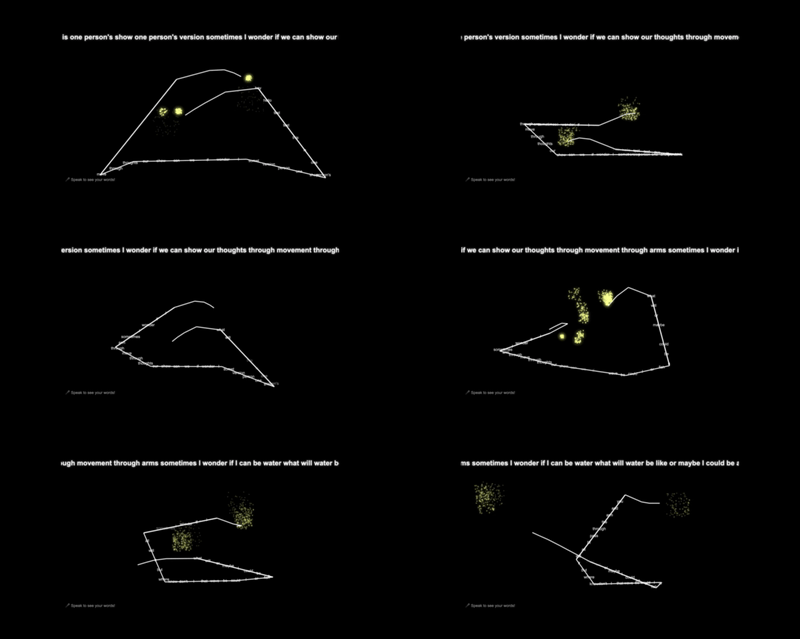

Maybe for next steps, I would love to explore the application/ real-world practice of how to translate// fuse// bring together all these ideas -- power dynamics & body, permeability of the body, networked system of the bodies (?)


MAKING:

first, here is a continuation from the week 6
https://dddyly.github.io/SharedMinds_6-9-BodyCocreate


(still a WIP) — playing with spoken text, and with the shape of the body -- how could we interact and position with the words that we said out loud? how to use body evne compose how the words/ text /-- poem could be written?

(still need to work on adding the server⬆️)


I ran some little tests/ experiments here:
experiment of text with the body; experiment about body with boundaries/ borders/ relationship with multiple bodies.


here are some documentation & thoughts:

https://yilinitpdoc.cargo.site/thesis


Week 8 : flattening?
Oct 29, 2025 


Space is a word that appear pretty often in my life. Metaphorically, I constantly use and hear the phrase "make space" -- providing space & resources for the people who need them.


Now that I'm remembering, my undergrad anthropology thesis topic is, "body & spaces in dance cyphers. " Back then, I had a lot of curiosities, not only about the dance cyphers in physical world (a circle of dancers, individual take turn to enter and freestyle), but also how the use of digital media and social media plays a role in the globalization of hip-hop and street-style inspired other dance trend. On one hand, the globalized use of social media has expedited the "global flow" of dance culture-- people from around the world could do the "Harlem Shake" (originated in Harlem in the 80s); how all the K-pop dance choreography are so rooted in hip-hop street-styles... All these travels and global exchange of culture is fascinating. On the other hand, the appropriation & commercialization of the culture make all these controversial as well.

A lot of people in the dance community would also talk about how people's way of dancing also changes, because of tiktok, short video platforms. the existence of the phone camera changes where's your attention, the placement of the phone directly in front of you affects your range of motion and how you perform, the length of each video (short video typically 10-20 seconds) shortens the need of practice, the audiences affects the your way of performance.

So many people from the dance community despise to consider the dance video on tiktok trend being dance. it is "tiktok dance."

This is so intriguing for me: how the medium and our engagement with new technology, subtly change the way we do the thing itself.


Back in my undergrad thesis interview with dancers, I asked them, would being in different spaces affect how you dance (answer is definitely yes)-- how environment affect how we perform. The space is not just the location-- it's almost feel like a state that encompasses the timing, the people, the energy, everything..


I've been very curious about the idea of how people could experience the story through space -- spatial storytelling. So I took a lot of some 3D game engine classes; but not sure how much a fan I am of VR-- esp for accessibility reason. I realize what intrigued me, is the exploration of story & connection in the physical tangible space.

But at the same time, I still like the 3D scanning & gaussians splatting -- for the archiving, also just the possibility of experiencing video in different way.

for example, experiencing a classical Chinese dance (video) in front of the statue in a 3D way--

https://www.4dv.ai/ysjf

In today's world, the 2D screen remains the most accessible medium. While flattening the 3D world onto a 2D screen may not feel intuitive, but the chance for exploration on website with 3D capacity & dynamics is so accessible (and could be fun). I think it is fine to recognize that, 3D on the screen is it's own "type" of experiencing -- just something that's different than our embodied world, and different than the tranditional 2D design web.


On the other note, I also thought about space as metaphor -- specifically, the idea of Panopticon by Bentham and further expanded by Focault. I was thinking, whether this is a proper metaphor for our day & time. Is the world we are experiencing right now a "digital panopticon"? Or if there are any other metaphors that would map out the state we are in right now, since the data collection & survillance almost feel like a "given" or default today(?) .


MAKING:

https://dddyly.github.io/SharedMinds_8-1-SpaceExperiment/


I originally want to try stuff with marble to generate gaussian splat but unfortunately could not get access. experimenting with three.js now... I encountered the source code from Spark, from this example that enables gaussian splats in three.js: (example here: https://sparkjs.dev/examples/#splat-shader-effects)


So I uploaded a 3d gaussian splat scan! want to experiment more with this!


Week 7 : metadata, meaning-making, High-dimensional relationality, time
Oct 22, 2025 


This week (today) I encountered this essay, Hallucinating sense in the era of infinity-content, which I found very resonating. In this essay, author Caroline Busta proposed, in the day of infinite content & more AI generated contents, perhaps we make meaning through the "meta-reading of the shape and feel of content" through the remix of traditional mediums such as codified text language, as well as broadcast medias in the recent century.


I have been trying to find the "answer" or discussion around this subject matte: how our relationship to all the existing mediums is changing with the use & evolvment generative A.I. products? How we use language, esp for younger kids to learn language; how we view and experience visual media that's hyper-real, now that app like Sora is out? How do we believe?


A point made by Busta, that seems refreshing:
"what if we thought about generative AI more as an expression of an epochal shift in human communication than a root cause? What if there’s something deeper, older, even organically emergent that has been nudging us to perceive and communicate in a fundamentally different way and “machine learning neural networks” are, rather, answering that call"


Busta indicates that "this form of compression [of machine learning] is fundamentally nonlinear. Yet unlike images, it encodes a meaning that is nevertheless definite and calculable. Loosely speaking, machine learning reads the shape and feel of a thing and assigns it a position in relation to N-number of other things, like a hyper-specific kind of connotative thinking." Although not exactly 100% , the very metaphor of "neural network" to human thinking and cognition, and the meaning it carries, is interesting.


In the last paragraph, author asked:
"What happens to our world when our space of communication—the space of intergenerational knowledge transfer—is determined not by writing, truth, and fact but by intuition, proximity, and hallucination? It means, I think, that we are newly free to renegotiate the metaphysical parameters of our reality. That may sound like hyperbole, but when we consider the degree to which the technology of writing contributed to our linear understanding of time, why wouldn’t this age of neural media enable us to experience time differently? Why wouldn’t it enable us to experience a new level of “the real”? Perhaps it already has"

This reminds me of our conversation in class last week, upon "truth." But even more so, here we are more talking about meaning-making -- what makes up the "truth" how would we make sense or interpret what is true, with the new technologies in our time, i.e. machine learning AI on the internet?


MAKING/ DRAWING:


This is very much inspired by the question, of how neural-network and neural media could inform us, a new ways of understanding time? Linear time is built off on our technology of writing. What would happen when we enter journals with multi-media pieces -- text, audio (music, speech/talk), visuals (recording videos, images, drawings, memes even?) -- all together, and the neural network would find that specific high-dimensional space after the remix from all the pieces that we feel / want to remember?

For the showing, there is no textual element -- inspired by also the claim, of how now we used to construct meaning and understand meaning through all the codified text & language. How to go back to a sensory experience through screen-based device? Color is visual but also simple enough that there is objective enough understanding of comparing/ listing/ juxtaposing. But if not visual or use color, I could also imagine maybe a vibration from the device, etc.


(originally i also wanted to design a purely no-text experience/ interface, only choosing or uploading audio visuals. )


I also wish to explore if extending to other non-screen interfaces, what are the possibilities? especially also adding the social / human-relation part.


Week 6 : 人之初 性本善(?
Oct 13, 2025 


I found Harari's talk so fascinating -- the two folds of realities, that we are living in nowadays as human beings, the objective reality, as well as the constructed fictional reality. The fictional reality is so powerful, that it literally shapes how we live our life-- how money is such an example for this large fiction, the idea of nation, religion, etc..

also, "how do you know if an entity is real or fictional?" -- to ask, can it suffer? suffering is the best test of reality.
when a nation lose or wins a war, the nation won't suffer, the people suffer
when a corporation goes bankrupt, the corp won't suffer, the people suffer.

I liked this way of looking & thinking, because eventually what is really REAL, is that, it all come down to people— and I hope this is a good way of fostering more empathy around us.


Following this thread of "fictional reality", I started to think, aren't all the theories or ways we make sense of the world more or less fictional? In the day & space we live in now, who developed the evolution theory and who is benefiting from it? What values are we diminishing, if we are all believing in the competition that is being emphasized in this theory? If we are obsessed over competition, who would suffer?


I was having a very inspiring conversation with a friend, who's a college freshman studying history; I exchange this idea of "fictional reality" with him. He is very interested in "religion" at the moment, and was telling me how this word or concept "religion" itself did not exist, in many of the "religions" that are not euro-centric — it was the way of living or part of their belief system. (I'm not an expert in this topic so please correct me if I'm wrong!!) The word "religion" itself is fairly new, and have strong association with Christianity. During the age of colonization, Europeans defined "religion"; In their colonies, they classify whether the people's way of living/ belief is "religion" or not, or even use the words such as "primitive" religion. For example, Hinduism was not considered as a doctrine "religion" by the people who has been living around, before the British colonization, but a really practice-based community-based one; and there is no canonized set of "sacred text" as Christianity; Colonial narratives, along with the effort to label converts as “minorities” and divide Indians, led to adopting the Avestan term “Hindu” and framing India’s diverse spiritual traditions under the single label using “-ism.” (which is actually deragatory).


Religions, or even larger, our values and beliefs in life, are really the largest collective stories that groups of people would believe in and act accordingly together. There are comparison between tech industry/companies to "cult", essentially how there is a whole belief system coming out or exhibiting in the tech industry. If using the lens of all religions and belief under "fictional reality", there's no wonder such crazy cults exists.


Going back to cooperation or competition (this binary view), it made me think of a common debate theme: is human nature inherently good or bad? People's answer to this are definitely influenced on the fictional reality, the stories that they got exposed to.


Now that I remember, one of the first ancient Chinese text that I learned to recite as a kid, goes,
人之初,性本善。 性相近,习相远。
People on earth,Good at birth. The same nature,Varies on nurture
——《三字经》Three Character Classic


MAKING (in progress)


Week 5 :  time, sequence, storytelling, truth & making sense of the world..
Oct 6/8, 2025 


I'm so sure how one thought came after another would be such a different process for everyone, and that's something we can't even communicate thoroughly -- something I became more aware of after taking this class, of courses. During the time of being in Shared Minds, I got more and more fascinated by how there are so in-explainable things within our thought processes (like a blackbox??) -- i guess this is how this class has "determined" or influenced me to think. We are constantly being new versions of ourselves, throughout time/ as we live. Even for our body, There's a "myth" that our cells are in constant state of renewal, and you would be a "new person" every 7-10 years.


A curated sequence is so different than the "flow of time" in real life. From my past experience in film studies & filmmaking, editing really is the KEY to (linear) time-based storytelling. You could have the same material & footage to work with, but with different ways of editing-- the pacing, the reference, etc -- filmmaker's intention and even emotion can really shine through -- and that is the art of editing.


Films, audio pieces, or any type of time-based media that is to be experienced through linear time, is differently a curated "thin slice of reality." But I don't think that's necessarily evil.

I still remember my first time independently editing a documentary film that I really care about, I was so surprised by how much power/ agency an editor/ filmmaker has in the story. I was shocked by how much of the film's reality is purely constructed through the editing; the immense power that they could yield over audiences' emotional reaction, just through putting footages in different order. This power is too much that I wasn't sure if I like it or not-- especially when it comes to working with footages & stories from people in real life, the living people around you with real emotions & everything.

But I realize, as I explore different mediums in ITP, that there is always the feeling/ message from the creator/ director/ maker that they want the others to see/ feel/ think. There is no absolute objectivity, just different levels & ways of communicating that subjectivity or intention.

The more I lean into documentary storytelling (especially after taking a first-person documentary class) the more I believe there is no absolute truth in these storytelling mediums -- everything would be biased in some ways. The beauty of first-person perspective non-fiction storytelling, is that filmmaker is being honest about where they are coming from, being transparent about their own emotions & feelings & intentions within that story.

And I think that's also what sets sincere artists & storytellers apart.


This past week, Sora's app also just came out. How AI-generated short videos are so accessible even on everyone's phone, and how that affects how we understand reality (now I realize I'm going on such a tangent from "time".. ) here's a quote from an AI educator that I found from Instagram, Nicole Hemenway, --
"The more confused we are, the easier it is to control what we believe is real. In a world where the surreal becomes ordinary, and atrocity sits next to AI-generated horror slop in the same feed, what grounds us? Why pay attention to anything at all—and how do we resist becoming spectators to our own alienation?"

-- full article here

but also, what keeps me more positive/ hopeful --
".. humans found ways organize and understand reality for many millennia before video was ever even invented. We’ll figure it out again."


MAKING:

https://dddyly.github.io/SharedMinds_5-1-dreamhouse/


referencing one of my favorite childhood internet game 买房子 buying house, under 开心网, back around 2010s. 开心网 used to be the most popular online community/ social media + game, but now the website is no longer hosted/ accessible.


After understanding the capacity of firebase, I immediately got the urge to make something that's like the retro-internet game, in the 2010s. Originally, I wanted to reference this dress-up game called "QQ show", that was part of the most popular social media/ messaging platform in China, QQ. However, it took me 24hr+ to be able to log in and also found out that the QQ show pages all cannot be loaded anymore. I wish I could have screenshotted my OOTDs in QQ shows, but now I could only trace the very limited pictures on Chinese Internet.


And this recall of the old internet experience reminded me of another game I used to be obsessed with, called "Buy House" 买房子 as part of a social media on PCs 开心网. I almost forgot how much I loved this game 买房子— how much i love painting the walls, decorating the room with different furnitures and even pets — and buying bigger house as I make more money from other games in this social media eco-system — until I saw this weeks' prompt and got into this waves of memory.

So I searched up the game too — very similarly, and very sadly, there is barely any trace for this game. Barely any pictures, any post about it; and the website itself has already been un-functional for a long time..


Digging into these internet experiences/ games/ sites/ social media that once was the most in trend, got me feeling a lot. When digital memory like this disappear as the website is not hosted anymore, I feel like having much less agency in keeping the archive/ proof for that memory, unless I screenshotted everything. These sites once feel like they are gonna be here forever, but as time passed by, 10+ years pass by, they barely leave that many digital traces...


Week 4 : (TBC)
Oct 1, 2025 


Social Media (Jonathan Haidt)

I found this week's reading on Social Media & Politics, very interesting. In how he addressed that the the social media's architecture, the reward of going viral for "rumors and half-truths." Also, how social media becomes a "public performance" instead of communication & connection. Now we have "online performance" artists who use social media as their platforms of art creations -- reflecting how this has been becoming a realm of "performance." I personally think we all be performing anywhere anytime, and that specific persona we put on// curate (more or less) for social media.


A democracy cannot survive if its public squares are places where people fear speaking up and where no stable consensus can be reached. Social media’s empowerment of the far left, the far right, domestic trolls, and foreign agents is creating a system that looks less like democracy and more like rule by the most aggressive.


So much of the division is created by rewarding the loudest// most aggressive voices, and ignoring the silent majority on the social media.


Latent Space & Embedding

In the hot take Latent Space, the Bridge between Minds and Machine, I found the parallel between AI latent space and human brain so interesting:
When Feynman says: “When we’re talking to each other at these high and complicated levels, we think we’re speaking very well, but what we’re really doing is having some kind of big translation scheme going on,” he describes something profound.
Think of AI embeddings as an attempt to create a “universal dictionary” — a shared mathematical space where translations are more predictable and consistent.

Language/ talking is the default of human communication & connection nowadays. But still, the inevitable lost of translation would still happen, even when we talk in the same language— because of our own perception & understanding & context (as small as this moment we talk, as big as each individual's upbringing & cultural heritage). This is fascinating.

When dancing, there are so many moments that when dance together // with each other, so much of the energy exchange and the feeling and the connection, I cannot find it in words. Now thinking about it, how could we anchor that in the spoken & written language even? The nature of that moment// that feeling is so hard to be anchored in a whole other communication system.


New Social Media (?)


When we put public discourse onto digital space of social media nowadays, so much of the context of each message/ post/ opinion are stripped away. The algorithm is so easy to trap us into our own echo chamber (Even thought this might also be the case of our lived reality too). Even for the app that I personally like, my feed is so catered to my own reality.


Alternative social media features that I'd like to have:
  • around 20 -30% percent of the content that shown to be would be something that's not 100% aligned with my own point of view -- would be interesting to see other ways of viewing & thinking.
  • providing context; time to pause& think (not sure how this would be manifested in the design)..
  • NO SCROLLING. the infinite downward movement gotta go. Maybe for screen transformation, either a traditional cut that change the frame, or spatial navigation, that's like a sphere (inspired by the 3blue1brown video). More exploratory, but doesn't feel like an absolute indefinite one.


MAKING:

still in the process of making .. will be updated!


Week 3 :  Language, Meaning-Making; how to care more on the embodied world?
Sep 24, 2025 


In How Language Works, Pinker's pointed out how linguistically, through grammar, combining words, we are able to come up with infinite amount of combination, for human expression -- "makes infinite use of finite media". Describing grammar as a "discrete combinatorial system (84)", he suggested the "blending system (85)" in contrary, like paint mixing, cooking, light, etc. However, when I read through, I wonder if these are really on the two side of the spectrum.


For me, how we use language is very similar to the "blending system" as well -- we blend words together, to create meaning that is so unique. Not only the different order/ combination of words means totally different things, even the same combination of words could mean so nuanced depends on the tones, context, etc. Plus the speaker and receiver side, how we interpret.


Language is so essentially to the meaning-making, world-making, and expression of ourselves-- our emotions, our beliefs, etc. One time i was having a conversation with a college friend who's now a film director/ script writer, about our experience in liberal arts college and the huge proportion of reading & writing we had to do. She said how she really appreciate that experience of working with words -- it informed so much of how one could express their own feelings. Sometimes we could feel some type of way but the inability to find & put together appropriate words/ combination of words limits one, even for understanding how they think. Since if we want to communicate with others, no matter thought or feelings, the most immediate medium always come to words. (or when I think, language & word is my first medium too).


Thinking about Large Language Model, AI ( interesting how our breakthrough in the machine learning marched first from the angle of language & chatting, humanizing the machine?) All of the sudden, so much of the written language online, in various contexts, is achieved with the help of, if not entirely, on AI// ChatGPTs. The question is, what is this doing to our understanding and the meaning of language, our ways ability to expressing and articulating the ways that we feel? To critically think? and to imagine the world we long for, and our wild wild imagination?? Especially for younger generation, the kids and teens, who are still developing their relationship with language, thinking -- thinking independently and critically structurally.


For The Divided Brain Ted Video, I enjoyed the ending part so much -- i thought it's so accurately put together, and reflecting the state we are in right now - the "paradoxical relationship" where we are constantly honoring the servant of "rational mind" and forgetting the sacred gift of "the intuitive mind" -- or our feelings.

Though I'm not sure how the right or left brain truly functions and connects, but I do agree that the society/ societal structure, under capitalism accroding to the western-centered modern & contemporary history, has been and still is constantly rewarding more on the "left hemisphere of the brain", or the more sharply focused narrowed rational mind. As McGilchrist has stated, the embodied world, the more concrete word, cannot be as "vocal" as the "left side// or the Berlusconi of the brain", in how it could controls the media.


This resonates with me so much from a perspective of a dancer, learning dance studies and experiencing the training and observing the scene and industry of dancers (for example how underpaid dancers are) Under the current system, in commercial world, the rational specific "science" are more valued; in academia, the knowledge is legitimate only when they are written down. This has all things to do with this mind-body dualism ..


The Body Knowledge: The knowledge from the body

I always think, how do we explore the knowledge that our bodies have always been carries with us. In the past, I have tried that with movement as the medium -- choreography that engaged with personal experience, studies of cultural roots, etc, as well as freestyling practices.

But how could I explore that further with other mediums?


Making:

https://dddyly.github.io/SharedMinds_3implicitexplicit/


Week 2 :  AI, machine + body, cyborg..?
Sep 16/23, 2025 


Biocentrism — the idea that consciousness first, and everything comes later! contrary to the traditional physics, according to Lanza, consciousness creates the cosmo around us. One thing I found so beautiful, is how we "carry the space and time around." Goes one step further than quantum physics, biocentrism argues that space, time, and reality itself exist only through consciousness.


Even though we've all learned physics and chemistry growing up, I still find biocentrism pretty plausible the first time officially encountering it by the academic name. I guess because of the experience I've had before, or maybe a shared experience of "exisitential crisis."


During one of the busiest and frustrating time in college, I remember one time I was on a train from school to the city, having a thought of "are these all real?" seeing the trees passing me by backward outside the train. I was imagining the space that I just left, there are still so many of my friends walking living studying at that same exact location, while the reality in front of me is this being still in this fast moving car, being transported to another complete setting of a "city" campus. Just this random thought of, how there are so many possibilities that I could be anywhere doing anything, but so many small decisions that I made or am making creates the very moment, the very present that's in front of me right now. Maybe back then (definitely very based on traditional physics) I was thinking, how is this possible, how could this be real, or what are the chances of what I'm experiencing through right now is my reality. But maybe through biocentrism, all I'm experiencing are constructed with my mind & consciousness.


The reading on trans-humanism and kurzweil got me thinking a lot. It was my first time exposing to the concept of "singularity" as well -- "the singularity means the moment when machine intelligence outruns human intelligence, producing exponential, unpredictable change.(quoted from ChatGPT)"

Recently I just watched the movie Mountainhead, a black satire on the tech founders & oligarchies who are controlling all the resources. The movie was ridiculous, even though I could only imagine how the reality would be. In the movie, one of the group founders were also obsessed with trans-humanism, also partly because he got incurable disease. And everytime when I look at current example of trans-humanism believers, I thought about the emperors in ancient China, especially Yongzheng Emporors in Qing dynasty (bc of anecdotes i heard of) — his obsession with Taoism and to concoct pills of immortality. So sometimes I wonder, maybe this is the "ultimate goal" that one (straight men??) would have, when they got to the highest position of power among everyone, and they just want to stick around forever?


I also thought about cyborg feminism, when reading cyborg // human + machine in the trans-humanism. Although sounds like a similar form of human body pluse machine == cyborg, the promise and goals are so different. I'm fascinated by how seemingly something that might even look or sounds alike, have such different promises. Cyborg feminism aims to reimagine gender, power, and future, breaking the binary views on things, etc. That the hybridity of cyborg destablize the binary views: nature v.s. culture, male v.s. female, human v.s. machine. It is unlike transhumanism, which see human body's ending as its very own limitation and use cyborg as an "enhancement" to live.


In general, I wish to tap more into AIs, computational ways behind machine learning and AIs, with the goal of demystifying AI and AGI, etc.

If biocentrism is true, then my consciousness would pretty much shape the world I experience every second. To better understand the logic/ behind the scenes of AI everything that's coming, is important demystifying and the very first step of re-imagining what is possible, of being speculative. So that my consciousness is able to recognize// consturct the world that we wish to live in, that is not on the premise of "transcending humanity " through immortality, but maybe something more human.


Make:

https://dddyly.github.io/SharedMinds_2Alignment_letsrethink/


Week 1 :  think, and feel, mediums of thinking & feeling & experiencing
Sep 9, 2025 


Rethink:

How I think, is a very interesting question being posted from last week's class. When I go by my daily life, I do not usually actively tracing down my own thoughts -- maybe except for free writing exercises, where I get to write down my stream of thoughts. I do practice meditation through various ways though -- mostly with Yoga.

During movement-based practices, it is easy for me to let the thinking pause and focus on the body movement. As a dancer, through free-styling, I could feel the "flow state", or the "black out state" as my dance teacher described. — a state when you are free-styling (maybe in a cypher, exchanging with other), when it's the right timing right music right people right energy around, your mind just goes blank and you are moving dancing without consciously thinking about anything, that the movement just come out from your body; after you are done, you come out and everyone says it's such a fire round and you don't even remember what exactly you did; and it's the best feeling ever. (I have personally experienced that and can confirm).

I think, but I do not think about how I think; I feel, and I would think about // feel about// practice on how I feel.

Coming from a liberal arts college, I resonated with David Wallace's This is Water so much. I am very conscious that my undergrad education in social science & humanities has shaped so much of how I experience the world, or in the speech how I "think", at large, and I'm very grateful for that. The ability of "critical thinking" sounds cliche but it is truly a real thing. After graduating college, coming out from the bubble/ cave, I realized how our ways of "construct meaning from experience" could be so different; but simultaneously, a muscle I'm need to constantly practice, is also to be genuinely open to different opinions.

This is Water, also reminds me of The Egg by Andy Weir (my fav video here got me very emotional). Every one we ever encounter in our lives, are also ourselves. It definitely helped me to think outside of the "auto-pilot" mode described by Wallace.

For the Interface Theory of Perception, I found it very interesting at first — it is a complete new ways of thinking about "reality" and "perception."
"reality is more like a 3D desktop that's designed to hide the complexity of the real world and guide adaptive behavior. Space as you perceive it is your desktop. Physical objects are just the icons in that desktop."

They all very logically make sense and I get that, but I don't know how much I would believe in this theory personally. The name itself is a little bit too tech-coded for me, from the word "interface" itself. Behind the name itself, it is essentially very evolutionary, emphasizing on "fitness." I personally tend toward constructionism a bit more (with my social science background).

In the house dance, we constantly say, "it's a feeling." (House is a feeling. It's the music, it's the dance) it's the energy.

One of my dance teacher used to say in class, imagine practicing dance, as making each body parts knows "how to think." -- and I think about this a lot too. This constant mind-body dualism. How thinking is always something only for the brain --

perhaps body can think too. Thinking could be embodied. And body have memories too.

Wallace said,
the really important kind of freedom involves attention and awareness and discipline and being able truly to care about other people. and to sacrifice for them over and over in myriad petty little unsexy ways every day. that is real freedom, that is being educated and understanding how to think.

For me, it seems to not only be how to "think", but to think, feel and experience through life.

But going back to minds, during the meditation exercise in class, I dd notice that my minds jumps from one thing to another, in no particular chronological or physical order. Interesting to think about how VR or environment building, in this case, could be so fundamentally different than how one's mind wanders around.


Making:

©yilin yeto imagine and reimagineNY | Sept 2024